
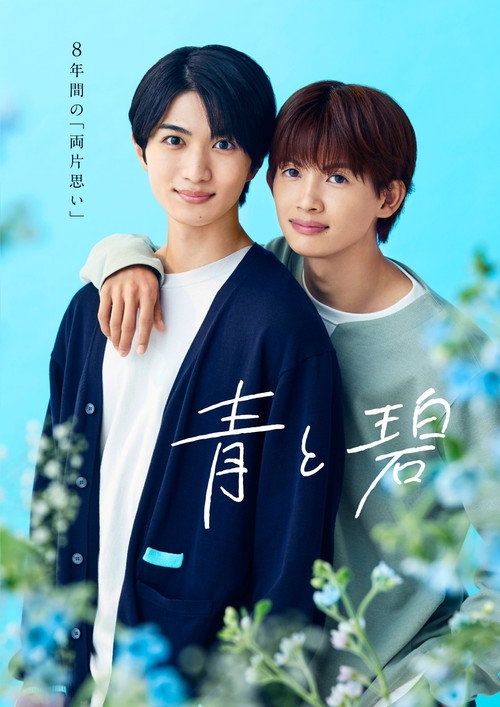
Key art for Ao to Midori, a 2026 Japanese BL television drama

Ao to Midori

UpcomingTV Series🇯🇵

SYNOPSIS

Ao to Midori (青と碧) is a Japanese boys' love television drama announced to begin in October 2026. No official English title has been issued, so this catalogue files it under the romanised Japanese; Blue and Green is a working rendering used elsewhere and is recorded as an alternative name. The drama has not yet been shown, and what follows is drawn from the official site and from advance coverage.

It is adapted from Roji's manga of the same name, published by France Shoin. TBS Growdia produces, with the subsidiary Cantor, from scripts by Yumi Shimo. Nao Nomura, Hitomi Kitagawa and Saki Domoto are credited as directors.

The release pattern is layered rather than simple. Lemino takes each episode first, at ten in the morning, ahead of any broadcast. BS Asahi then carries it on Mondays at 23:24, with CBC, RKB, HBC and tvk following in sequence afterwards. The official site commits only to distribution and broadcast starting from October 2026; the specific 5 October slot on BS Asahi comes from Real Sound's autumn line-up rather than from the production itself, and is recorded here on that basis.

The story follows two boys who meet at high school and stays with them for roughly eight years. One is effortlessly capable and openly warm; the other is quietly attentive and careful never to want too much. Neither says anything. Both keep adjusting themselves to what is expected of them, and the drama is built around how long two people can carry a mutual feeling without either naming it.

Naoya Kusagawa (草川直弥) of ONE N' ONLY and Hidekazu Chinen (知念英和) lead, with Ryota Aoyama, Noa Tsurushima and Bambi Fujimoto also announced. An episode count has not been published anywhere consulted, nor has a running time or a content rating, and those fields are left empty here.

CONTENT DETAILS

Native Title
青と碧
Original Title
Ao to Midori
Also Known As
青と碧, Blue and Green
Adaptation
Adapted from the manga Ao to Midori (青と碧) by Roji, published by France Shoin. No chapter or volume count for the source work appears in the announcements consulted.
Themes
Key Themes
High School RomanceEight-Year SpanManga AdaptationUnspoken FeelingLate-Night BroadcastStreaming-First ReleaseRegional Station RelayComing Of AgeSelf-EffacementUnreleased Production
Country
Language
Japanese
Seasons
1
Aired Start
Release Year

KEY TAKEAWAYS

  • Announced Window: The official site gives October 2026; advance coverage places the first BS Asahi broadcast on 5 October at 23:24.
  • Streaming First: Lemino carries each episode at 10:00 ahead of any broadcast, with BS Asahi, CBC, RKB, HBC and tvk following.
  • Manga Adaptation: The source is Roji’s manga Ao to Midori, published by France Shoin.
  • Production Credits: TBS Growdia produces with Cantor; Yumi Shimo writes; Nao Nomura, Hitomi Kitagawa and Saki Domoto direct.
  • Announced Cast: Naoya Kusagawa of ONE N’ ONLY and Hidekazu Chinen lead, with Ryota Aoyama, Noa Tsurushima and Bambi Fujimoto.
  • No Official English Title: The record is filed under the romanised Japanese, with Blue and Green noted as a working rendering.
  • Length Unknown: No episode count or running time has been published for a story said to span roughly eight years.
  • No Score Recorded: The drama is unbroadcast, so no editorial score has been given.

EDITOR’S VERDICT

Reviewed by Renkaze, editor of BL & GL Flix

What the announcement confirms

An October 2026 start, adapted from Roji's manga for France Shoin, produced by TBS Growdia with Cantor, written by Yumi Shimo and directed by Nao Nomura, Hitomi Kitagawa and Saki Domoto. Lemino streams each episode first at 10:00, ahead of a BS Asahi broadcast, with CBC, RKB, HBC and tvk following. Naoya Kusagawa and Hidekazu Chinen lead, alongside Ryota Aoyama, Noa Tsurushima and Bambi Fujimoto.

What it does not

The official site gives only the month. The 5 October date and the Monday 23:24 BS Asahi slot recorded here come from Real Sound's autumn line-up, not from the production, and should be treated as the firmer of two available claims rather than as confirmed by the broadcaster. No episode count has been published, no running time, and no content rating. The dates on which the four regional stations pick the drama up are described as sequential but are not individually specified. Character names have not been released, so the announced cast cannot be mapped to roles.

What would change this record

Broadcast, and the official site's own schedule page once it firms up. An episode count would let the eight-year span described in the source be measured against the time available to dramatise it, which is the thing most worth knowing about this adaptation. A note of caution for anyone updating this entry later: the lead is Naoya Kusagawa, 草川直弥. This catalogue separately holds a profile for Takuya Kusakawa, 草川拓弥, who is a different performer and is not in this production. No score is recorded here, as nothing has been seen.

FREQUENTLY ASKED QUESTIONS

When does it start?

The official site commits only to October 2026. Real Sound's autumn line-up places the first BS Asahi broadcast on Monday 5 October at 23:24, and that is the date this record uses.

Where can it be watched?

Lemino gets each episode first, at ten in the morning. BS Asahi then broadcasts it, followed in sequence by CBC, RKB, HBC and tvk.

Is it a sequel?

No. It is a first adaptation of its source manga and has no earlier season.

Is this based on something?

Yes, the manga Ao to Midori by Roji, published by France Shoin. No chapter or volume count for it appears in the announcements.

Why is the record filed under a Japanese title?

Because no official English title has been issued. Blue and Green is a working translation used elsewhere and is recorded as an alternative name, but inventing an English title and presenting it as the work's own would misrepresent it.

How many episodes is it?

Not stated anywhere consulted. Late-night Japanese dramas of this type commonly run eight to twelve episodes, but the production has not confirmed a number and this record does not assume one.

What still has to wait for transmission?

Most of the numbers, since nothing has gone to air yet. Episode count, running time, content rating and per-episode dates are all recorded here from transmission, and a catalogue that guessed at them would be less useful than one that leaves them visibly empty.

An unbroadcast production is described here from advance material, and one of its key details, the exact start date, rests on trade coverage rather than the official site. Announced schedules change; our site disclaimer covers corrections.

What Ao to Midori is about

Eight years is an awkward quantity of time for a late-night Japanese drama to hold. The slot these productions occupy typically buys eight to twelve episodes of roughly half an hour, which is somewhere between three and six hours of screen time in total, and a story that begins in a school corridor and ends most of a decade later has to spend a good deal of that budget simply moving people through their lives.

The source form does not have the same problem. A manga can leave four years in a gutter between panels and trust the reader to feel the gap rather than watch it pass. Serialised over months or years, it also lets the reader's own elapsed time do some of the work, so that a character's slow change is registered in a way no compressed adaptation can reproduce. Television has to choose: compress, and the years become captions; dramatise evenly, and the early material thins out.

The premise makes that structural choice unusually consequential. A story in which nothing is said depends entirely on accumulation, on the reader noticing the hundredth small accommodation rather than the first. Strip out enough of the intervening years and the restraint stops reading as restraint and starts reading as an absence of plot. Whether this adaptation finds a workable ratio is the most interesting question hanging over it, and it is not one an announcement can answer.

Metadata and images courtesy of TMDB. This product uses the TMDB API but is not endorsed or certified by TMDB. All posters, portraits, cover art, and promotional materials remain the property of their respective copyright holders and are shown solely to identify the works described. BLGLFLIX does not host or distribute any video content. See our DMCA / Copyright Policy.