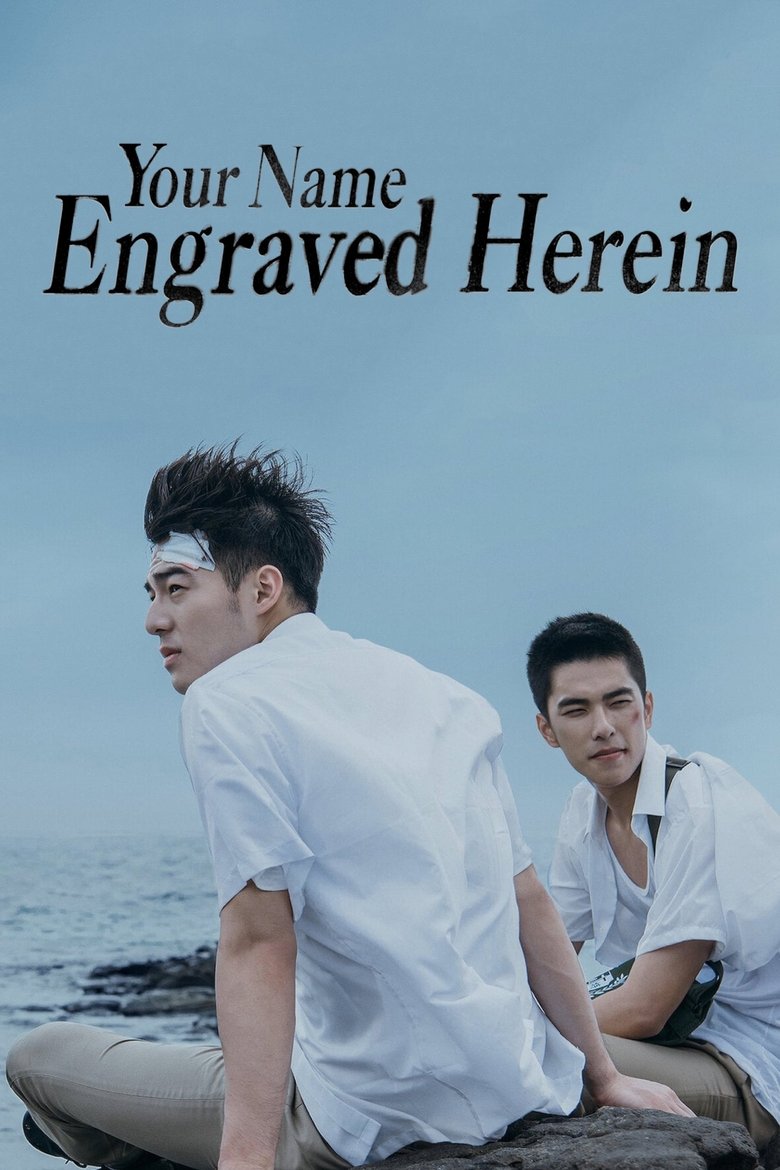
Your Name Engraved Herein is a 2020 Taiwanese BL romance film from Netflix, starring Edward Chen and Tseng Jing Hua.
Martial law has just been lifted in Taiwan, and none of it has reached the corridors of a Catholic school yet. A-han (Edward Chen) and Birdy (Tseng Jing-hua) meet in the school band, where Father Oliver (Fabio Grangeon) urges his students to profiter du moment, and are inseparable almost at once. The outside world keeps arriving anyway: the school begins admitting girls, among them Ban Ban (Mimi Shao), and a national funeral supplies the pretext for a trip to Taipei together.
What they cannot do is say what this is. Family expectation, the pull of a conventional path and the limits of what can be told to a confessor keep the question shut.
Naming is the film’s persistent concern and 1987 is its instrument, the political opening letting Liu Kuang-hui measure how slowly private life follows public change. The film also carries sections set decades on, with Leon Dai and Jason Wang as the two men grown up, which makes memory part of its structure, not an afterword. Liu built the screenplay by merging two projects he had already developed, working with his old classmate Chu Yu-ning, who is credited as writer and executive producer.
He cast for authenticity over name recognition, then set his leads homework before shooting: Happy Together and Blue Is the Warmest Colour, with Chen asked to work from Tony Leung and Tseng from Leslie Cheung. The budget grew from NT$30 million to NT$70 million, much of the increase going on a Canadian leg, and a school in Taichung stood in for the campus.
The 114-minute film premiered at the Osaka Asian Film Festival in March 2020, opened in Taiwan through Sony Pictures that September and went worldwide on Netflix in December. It became the first gay-themed film to pass NT$100 million at the Taiwanese box office and the highest-grossing LGBTQ film in the country’s history, took Best Cinematography and Best Original Film Song at the 57th Golden Horse Awards, and Crowd Lu’s theme later won Song of the Year at the Golden Melody Awards.
Editor’s review3 min read
Some films you watch. This one you carry around for a week afterwards. Your Name Engraved Herein is the Taiwanese film to pick when a friend asks for “something with real weight.” Then brace yourself for the “why did you do this to me?” message.
Martial law has just been lifted in Taiwan, but none of that freedom has reached the halls of a Catholic school yet. That gap is the whole engine of the film. A-han (Edward Chen) and Birdy (Tseng Jing-hua) meet in the school band, where Father Oliver (Fabio Grangeon) tells his students to profiter du moment, seize the moment, and the two become inseparable almost at once. What they cannot do is put a name to what they share. Family expectation, the pull of a conventional path and the limits of what can be told to a confessor keep the question locked away. Director Liu Kuang-hui uses the year as a measuring stick: the country opens up, and private life crawls behind.
The world keeps arriving whether the boys at the school are ready or not. The school starts admitting girls, including Ban Ban (Mimi Shao). The national funeral of President Chiang Ching-kuo becomes the acceptable excuse for a trip to Taipei together. Every one of these details pushes on the bond between A-han and Birdy, and the film is brilliant at showing how much can live in what nobody is allowed to say. If you love period dramas, slow ache and stories built on silence, keep the tissues within arm’s reach.
Here is what lifts the film into something special: it is built in two time frames. Leon Dai and Jason Wang play the two men grown up, decades on, and those later sections turn the school years into memory. The adult story brings them back together in Quebec City, which is also where Father Oliver comes from, and the film closes at Niagara Falls. Memory is not an epilogue here. It is the structure. That is also why the budget grew from NT$30 million to NT$70 million, with much of the increase going on the Canadian leg.
Behind the scenes, Liu built the screenplay by merging two projects he already had, working with his old classmate Chu Yu-ning, the creator of It Started with a Kiss, who is credited as writer and executive producer. Liu cast for authenticity over name recognition and then gave his leads homework: Happy Together and Blue Is the Warmest Colour, with Chen working from Tony Leung and Tseng from Leslie Cheung. Viator Catholic High School in Taichung stood in for the campus.
The results speak loudly. It was the first gay-themed film to pass NT$100 million at the Taiwanese box office and became the highest-grossing LGBTQ film in the country’s history. At the 57th Golden Horse Awards it won Best Cinematography for Yao Hung-i and Best Original Film Song, and Crowd Lu’s theme went on to win Song of the Year at the 32nd Golden Melody Awards. Fair warning: once you hear that song, it will follow you around for days.
The film runs 114 minutes, premiered at the Osaka Asian Film Festival in March 2020, opened in Taiwanese cinemas through Sony Pictures on 30 September 2020 and went worldwide on Netflix on 23 December 2020. Check your own region’s Netflix listing. There is also a novelisation of the screenplay if you want to stay in this world a little longer.
Choose it when you want a restrained period drama about what goes unspoken, told across two timelines, and make peace with a good, long cry, because it is part of the deal. The mood is tender and devastating in the most beautiful way. It is a film, not a binge, so give it a quiet evening all to itself.
The first thing I always point out is the timing. The film is set in the months after martial law ended in Taiwan, and it uses that huge political opening to show how slowly private life catches up with public change. The Catholic school, its band and its priest set the rules the characters live by, while co-educational classes and the trip to mourn President Chiang Ching-kuo mark the outside world pushing its way in.
Then the title, and the obsession with names. What can two people call each other? What can be said to a confessor? What stays unsaid for decades? Religion, family expectation and the pull of a normal life frame everything, and the adult sections return to the same events years later, until memory itself becomes the subject. The name is never spoken. It is engraved.
And this went big. Sony Pictures released it in Taiwan as a mainstream commercial film, Flash Forward Entertainment handled international sales, and it had a private screening at Berlin’s European Film Market before its Osaka premiere. It became the most popular Taiwanese film of 2020, then Netflix took it worldwide that December. A quiet story about silence, heard by a huge audience. I love that irony.
Patrick Kuang-Hui Liu (柳廣輝) directed, and he built the screenplay by merging two projects he had already developed, 心天堂樂園 and 野孩子, with his classmate Chu Yu-ning (瞿友寧). The screenplay is credited to Chu and Zhan Jie (詹傑), and the script was finished roughly two and a half years before cameras rolled. Chu also worked as executive producer and on-set acting coach, with Chen Bao-ying as producer. Oxygen Film produced alongside Baiyue Digital Creative, Zhonghuan International Entertainment, Manman Entertainment and San Huang Biotech, and Sony Pictures Releasing Taiwan distributed.
The money story is wild. The budget grew from NT$30 million to NT$70 million, with more than NT$10 million of that increase going to Canada, where the Quebec section made up about a fifth of the total and drew a 20 percent tax refund. Chu insisted on going abroad because the priest character comes from Quebec, and late in pre-production he added a further ending sequence. The Canadian leg was five actual shooting days inside a thirteen day trip, running from southeast to northeast Quebec with more than ten hours of driving each way, capped at eight hours a day under local labour rules. Chu’s principle: if investment only aims not to lose money, good work never gets developed. Back home, Viator Catholic High School in Taichung stood in for the campus.
Liu picked Edward Chen and Tseng Jing-hua for authenticity over name recognition, hoping to find more genuine, purer souls, and gave them homework: Happy Together and Blue Is the Warmest Colour, with Chen working from Tony Leung and Tseng from Leslie Cheung. Tseng already had a Golden Horse nomination for Detention. Leon Dai and Jason Wang play the adult A-han and Birdy, and Fabio Grangeon is Father Oliver.
The 114 minute feature screened at the Osaka Asian Film Festival in March 2020, held previews on 25 to 27 September, opened in Taiwan on 30 September 2020 rated 保護級 (Protected), and hit Netflix worldwide on 23 December 2020. Crowd Lu (盧廣仲) sings the theme 刻在我心底的名字, with music by Keon Chia and Tan Boon Wah and lyrics by Hooi Yuen Teng; its official video arrived on 24 August 2020 through 添翼音樂 TEAM EAR MUSIC. The score album 《刻在你心底的名字》電影配樂原聲帶 is credited to Chris Hou (侯志堅), Chen Chu-hui (陳主惠) and Wei Kuang-hao (魏廣晧). It is an original screenplay, though a novelisation exists: 刻在你心底的名字:劇本原創小說 by Di Fer, from 水靈文創 on 1 September 2020, 176 pages, ISBN 9789869945912, covering the same characters and thirty year span, in shops before the film, with a signed edition too.
Viator Catholic High School in Taichung as the campus, and the National Revolutionary Martyrs’ Shrine in Taipei for the 1988 mourning sequence.
Spoilers ahead. These scenes give away plot points.
From the watchlists of fans on this site. Add it to yours with the watchlist button.
5 quick questions. Members earn 1 fan point per right answer, once per quiz.
Written and verified by Renkaze · Last updated 4 November 2026
No fans follow this title yet. Follow it and you are first in line.
Fans who follow this title, by fan points. Only public fan pages are listed.
Your score
1 fans have this in their list








Discussion 0 comments
Join other fans talking about Your Name Engraved Herein. Be kind, no spoilers without tags, no spam.
No comments yet.
Share the first reaction below.